Genesis 13 and the Lost Geography of Divine Habitation
Governing Thesis
If Moffatt’s Zoan-reading is granted as a serious textual possibility, and if “park” renders Hebrew gan with its force of watered, enclosed, cultivated sacred space, then the Avaris–Pi-Ramesses complex becomes the strongest material analogue for “the Eternal’s own park.” Avaris supplies a water-bound royal-sacred landscape centered on harbor, palace, storm-god precinct, tree-grove, vineyard, and artificial lake; Pi-Ramesses expands that inheritance into a monumental royal-temple-harbor city; Tanis/Zoan later receives the displaced sacred architecture and preserves the name toward which Moffatt’s phrase points.
Prayer Before the Search
Lord God Almighty,
Eternal Father, Maker of heaven and earth,
You who walked in the garden,
You who spoke to Adam, Cain, Abram, Moses, and the prophets,
You who reveal and conceal according to wisdom,
guide this search.
Let no ambition corrupt it.
Let no novelty seduce it.
Let no fear of man silence it.
Let no hunger for discovery outrun truth.
Grant us the Spirit of wisdom and understanding.
Teach us to distinguish resemblance from identity, possibility from proof, and sacred wonder from scholarly intoxication.
Let the evidence speak in its proper measure.
Let the text rule over imagination.
Let reverence sharpen reason, not replace it.
If this path is fruitful, open it.
If it is flawed, correct it.
If it is premature, restrain it.
If it is appointed for edification, make it clear.
May the work produce good fruit: humility, truth, courage, clarity, and worship.
May it glorify not the searcher, but You, the Eternal, whose presence sanctifies place, history, word, and flesh.
Amen.
Preface: The Path and the Oath
This work began with a single strange phrase in James Moffatt’s rendering of Genesis 13:10. Lot, surveying the Jordan basin before the destruction of Sodom and Gomorrah, beholds a region “well watered in every direction.” Then the comparison comes: it was “like the Eternal’s own park, like the land of Egypt on the way to Zoan.” The phrase is too large to be ornamental. It gives not merely fertility, but possession; not merely abundance, but direction; not merely an Edenic mood, but a road.
The inquiry that follows does not claim that the matter is settled. It claims something more severe and more useful: that Moffatt’s Zoan-reading, when treated as a serious textual possibility, opens a line of sacred geography that has not been exhausted by conventional readings. The usual reading, Zoar, remains the majority path. Zoan is a minority path. But the minority path is not a fantasy. It is attached to an ancient versional witness, to biblical geography, to the field of Zoan in Psalm 78, to the northeastern Delta, to Tanis, to Rameses, to Avaris, to buried Nile branches, and to a world where water, enclosure, temple, palace, road, and divine action gather in one charged landscape.
This essay therefore advances by disciplined astonishment. It does not proclaim discovery where evidence warrants only pursuit. It does not retreat into safety because the path is contested. It asks, with severity: what remembered place was the Jordan basin said to resemble?
The answer proposed here is not that the Eternal’s own park has been found in the vulgar sense. No inscription has yet been produced bearing that name. No spade has uncovered a sign reading “the Eternal’s own park.” The thesis is subtler: the phrase may preserve, or at least expose, a memory of a sacred-watered Delta precinct associated with the road to Zoan. The strongest material analogue now appears not in Tanis alone, nor in Goshen alone, but in the broader Avaris–Pi-Ramesses–Tanis corridor: a migrating sacred geography whose components can be traced through palace garden, storm-god precinct, harbor, canal, internal lake, temple enclosure, royal capital, and later displacement to Zoan/Tanis.
The map has opened. The road leads northeast through the Delta. Its name is Zoan. The search begins under an oath: wonder must never be permitted to outrun evidence, and evidence must never be permitted to suffocate wonder.
Discernment at the Garden Wall
The Holy Spirit does not require the scholar to exaggerate evidence in order to honor Scripture; He requires the scholar to love truth enough to wait for it.
The search begins under a spiritual and scholarly rule: we do not seek confirmation; we seek truth. That rule is not a restriction upon wonder. It is the condition under which wonder becomes trustworthy.
This inquiry must therefore resist five temptations. The first is intoxication: the moment a possibility becomes beautiful, the undisciplined mind begins treating it as discovered fact. The second is overclaim: to say “therefore” where the evidence only permits “perhaps.” The third is sensationalism: to turn a contested reading into spectacle, because spectacle is easier than argument. The fourth is contempt for majority readings: Zoar remains the received path, and its narrative strength must not be dismissed merely because Zoan opens a grander road. The fifth is the desire to make the thesis grander than the evidence permits.
The virtues required are equal in severity: reverence, patience, courage, sobriety, and humility before the unknown. Reverence permits Scripture to be strange without making it a servant of private brilliance. Patience lets fragile evidence mature. Courage follows a minority path without pretending it is uncontested. Sobriety keeps the verbs honest. Humility remembers that a hidden thing may still glorify God.
The rule of the search is therefore simple:
Say only what the evidence permits. Ask everything the evidence invites. Worship the God who is not diminished by restraint.
Wonder opens the road. Evidence marks the path. Wisdom decides the pace.
Part I
Genesis 13 and the Lost Geography of Divine Habitation
1. The Clause That Opens the Map
They stand like sentries at the gates of the text, these preconceived notions, admitting familiar meanings and turning back stranger ones. Under their governance, Eden becomes the only garden; divine walking becomes a picturesque anthropomorphism; Egypt becomes only the future house of bondage; and Zoan becomes a geographical inconvenience. The result is a tidy Bible, and therefore a diminished one.
Genesis is not tidy.
In Genesis 13, Abram and Lot stand at the edge of division. Their wealth has outgrown their shared encampment. The land cannot bear them both. Abram, already living under promise, yields first choice to Lot. Lot lifts up his eyes and surveys the Jordan basin, well-watered in every direction. Then comes Moffatt’s remarkable rendering: “it was like the Eternal’s own park, like the land of Egypt on the way to Zoan.”
The words should be permitted to strike.
Not “a garden.” Not merely “a fertile district.” Not a vague pastoral compliment. “The Eternal’s own park.”
The possessive is the detonation.
The text, in Moffatt’s rendering, does not merely say that the Jordan basin resembled a lush region. It compares the basin to a place bearing divine possession: the Eternal’s own park. And then, in the same breath, it locates the analogy by reference to Egypt, “on the way to Zoan.” This is not Eden in the ordinary inherited reading. Eden was the habitation of Adam and Eve, the sacred enclosure of the first covenantal family. Genesis 13 appears to gesture toward something else: another geography of divine nearness, another set-apart precinct, another memory of the time when the Eternal’s earthly manifestation was not yet veiled behind bush, cloud, fire, tabernacle, and temple.
This is the startling possibility: Genesis 13 may preserve a trace of divine terrestrial habitation beyond Eden. The Jordan basin is not being compared to an idea. It is being compared to a place.
2. Eden Was Not Merely a Garden
Eden must first be restored to its proper severity.
It was not scenery. It was not an orchard for religious sentiment. It was a place apart, a precinct, a habitation under command. Adam was placed there. Eve was formed there. The Eternal walked there. The covenantal family heard Him there. The first disobedience occurred there. The first hiding occurred there. The first judgment was spoken there. The first expulsion was enacted there.
Eden was the domestic sanctuary of primordial revelation.
Moffatt’s own translation strengthens the point. In Genesis 2, he writes that God the Eternal planted a park in Eden, placed the man there, made trees grow there, and had a river flow from Eden “to water the park.” In Genesis 3, the man and his wife hear the sound of God the Eternal walking in the park and hide among its trees. The same English word, park, is therefore not an incidental flourish in Genesis 13. Moffatt has chosen it as his English vehicle for Edenic enclosure, water, planting, divine possession, and human vocation.
But the force of Genesis 13 lies in the possibility that Eden was not the only sacred geography remembered by the ancient text. Eden was Adam’s habitation with God. Yet Genesis 13, in Moffatt’s translation, may indicate another place apart: not Eden, but “the Eternal’s own park,” associated by the narrator with Egypt on the way to Zoan.
If so, the passage opens a door that later doctrinal tidiness has been anxious to keep closed.
It suggests a world in which God’s earthly manifestation was once more immediate, more geographically particular, more startlingly embodied in the affairs of the covenantal family than later readers have been trained to imagine. The Eternal walks in the park. The Eternal speaks to Cain. The Eternal appears to Abram. The Eternal visits, warns, bargains, commands, blesses, judges. Later manifestation becomes increasingly mediated: a burning bush, a mountain wrapped in terror, a cloud, a glory, a sanctuary, a voice from between cherubim.
This is not progress from myth to theology.
It is withdrawal.
Or, more carefully: it is transformation of presence.
3. Lot’s Error: Resemblance Without Covenant
Lot’s error now becomes more terrible.
He is not merely choosing good pasture. He is not merely choosing a region that resembles Eden. He is choosing a landscape whose appearance recalls divine habitation. He sees a basin bearing the look of sacred abundance, a land whose waters evoke the Eternal’s own park.
But he does not ask whether the Eternal is there.
This is the fatal distinction.
Abram moves by promise. Lot moves by resemblance. Abram receives land by divine speech. Lot chooses land by visual analogy. Abram stands under covenant. Lot is seduced by sacred-looking geography detached from covenantal discernment.
The Jordan basin appears like the Eternal’s own park, but its cities are Sodom and Gomorrah.
There is the terror.
A place may bear the visual signature of sacred abundance and still be morally doomed. A land may resemble divine habitation and yet be appointed to fire. The eye may recognize splendor while the soul misses judgment.
The resemblance of holiness is not holiness.
Lot sees water. Abram receives word. There is the whole distinction.
4. The Lost Age of Manifestation
The larger implication is immense.
Genesis may be remembering an age when the Eternal’s presence on earth was not yet reduced, in human experience, to mediated signs. He walked. He spoke. He appeared. He visited. He ate with Abraham’s household in mysterious form. He judged cities. He marked Cain. He made covenant. He moved among the covenantal family with a directness later generations would know chiefly through flame, cloud, angel, shrine, oracle, and glory.
Modern readers have been trained to call such language anthropomorphic and then to move on.
But the text does not move on so quickly.
It lingers. It gives locations. It names parks, trees, oaks, altars, roads, cities, rivers, plains, mountains. It makes divine encounter geographically heavy. The Eternal is not an abstraction floating above the patriarchal world. He is encountered in places: Eden, Nod’s borderlands, Mamre’s oaks, Moriah, Bethel, Sinai – and perhaps, in this neglected phrase, His own park near the Egyptian road to Zoan.
Such a reading does not flatten God into a local deity. It does the opposite. It restores the scandal of biblical particularity. The God of all the earth chooses places. He sets apart land. He marks precincts. He meets families. He binds Himself to promise in geography.
The Eternal is not embarrassed by location.
Part II
Textual and Geographic Warrant
5. The Witness Must Be Fixed: Zoar, Zoan, and Moffatt
The first object is not the map, but the text.
Moffatt’s rendering is not the conventional one. Many English translations read Zoar, not Zoan, at Genesis 13:10. The commonly printed Hebrew text has Zoar, and the Sodom-Zoar context of Genesis 13 and 19 gives the majority reading obvious narrative strength. This fact must be stated, not hidden. Concealed difficulties become later humiliations.
But the caveat does not close the inquiry. It clarifies it. Moffatt’s translation is not a casual paraphrase inserted by a devotional amateur. He presents his Old Testament as a new translation, not a revision of an English predecessor, and describes his aim as rendering the Old Testament in effective, intelligible English in light of modern research. He also deliberately renders the divine name as “the Eternal,” a choice he explains as a considered alternative to printing “Yahweh.”
Nor is Moffatt’s “Zoan” solitary eccentricity. The Cambridge Bible note on Genesis 13:10 records that another reading, Zoan, is found in the Syriac Peshitta, and that this reading would connect the clause with Egypt by specifying the fertile district of Tanis in the eastern Nile Delta. This is the first thunderclap. Moffatt’s reading stands in relation to an ancient versional witness and to a recognizable geographical logic.
The real textual question, therefore, is not, “Did Moffatt invent Zoan?” He did not. The better question is why Zoan became secondary. The simplest answer is that the Masoretic line, reinforced by the Sodom-Zoar context, proved dominant, while the Syriac-style Zoan reading was preserved as a minority path. In other words, Zoan was not necessarily suppressed so much as subordinated by the stronger transmission line of Zoar. That is a narrower claim, and therefore a stronger one.
We are not claiming that Moffatt’s “Zoan” is the majority reading. We are asking what becomes visible if Moffatt’s reading preserves, recovers, or conjecturally exposes an older geographic association obscured by the conventional “Zoar.”
This is the first rule of the expedition: do not pretend the path is uncontested. Walk it because it is worth testing.
6. Zoan Fixed on the Map
Zoan is not mist.
When the Bible refers to Egyptian Zoan, the site is commonly identified with Tanis, modern San el-Hagar or Ṣān al-Ḥajar, in Egypt’s northeastern Nile Delta. The identification is stable enough to become the first coordinate of the search. Tanis is an ancient Delta city; biblical Zoan is its scriptural name; San el-Hagar is its modern locality.
The first coordinate, therefore, is: Tanis / Zoan / Tell San el-Hagar, approximately 30.975 degrees north, 31.883 degrees east. This fixes the destination. It does not yet identify the park.
Here the impatient reader must be restrained. The city of Tanis is not automatically “the Eternal’s own park.” The phrase says “on the way to Zoan,” not simply “in Zoan.” A road is not a dot. An approach is not merely an endpoint. The sacred precinct, if the phrase remembers one, may lie in the Delta corridor associated with Zoan rather than within the later urban ruins themselves.
The map gives us a point. The text gives us a path.
7. The Field of Zoan
The second question is whether Zoan could function broadly – not merely as an urban point, but as a surrounding field, district, or approach. Here the evidence is decisive enough to continue.
Psalm 78 twice speaks of God’s wonders in Egypt as occurring in the “field of Zoan.” The Hebrew phrase in Psalm 78:12 is commonly rendered “field of Zoan,” and Psalm 78:43 repeats the same geography for the signs and wonders of the Exodus. Traditional notes identify this as Tanis and describe the “field of Zoan” as a rich flat tract east and south of the city, extending toward Pelusium. Other older geographic sources describe the region in terms of fields, plains, marshes, pastures, and water.
This is our second opening: Zoan is not merely a dot on a map. In biblical usage, the field of Zoan can designate a surrounding Egyptian region – a field, territory, plain, or district associated with the city. That matters immensely. It means that “on the way to Zoan” need not mean the city gate alone. It may indicate a corridor, a district, a watered approach, a Delta landscape known by the name of its great city.
The sacred precinct, if it existed, need not be found under the walls of Tanis. It may lie in the field of Zoan.
Other biblical references thicken the memory. Numbers 13:22 says that Hebron was built seven years before Zoan in Egypt. Whether or not that chronological note can now be historically verified in modern archaeological terms, its biblical function is unmistakable: Zoan is a known Egyptian landmark against which antiquity may be measured. Isaiah 19:11 denounces the princes of Zoan as fools, assuming Zoan as a political-intellectual center. Isaiah 30:4 places Judah’s officials at Zoan and envoys arriving at Hanes, locating Zoan in the diplomatic geography of Egyptian statecraft.
Scripture remembers Zoan in three registers at once: as a city, as a region, and as a theater of divine and political action. That is exactly the kind of layered geography in which a remembered sacred precinct could survive.
8. The Road Is Not Decorative
Moffatt’s phrase does not say simply “Egypt.” It says, with peculiar force, “on the way to Zoan.”
That phrase gives directionality. It imagines a route. It places the comparison not in Egypt generally, but in relation to an approach toward Zoan. The “way” may be literal, remembered, conventional, or textual; but in any case it is not empty. Scripture has made the geography directional.
A road in the ancient world is rarely a single clean line. It is a corridor of use: paths, waterways, military stations, pasture, marsh-margin, cultivated zone, shrine, ferry, canal, and settlement. To reconstruct the way to Zoan is not to draw a modern highway with insolent confidence. It is to recover a world of movement.
Egypt’s northeastern Delta was precisely such a world: the threshold between Egypt and Asia, between the Nile and Canaan, between riverine abundance and desert road. Later Egyptian geography gives us the famous Way of Horus, a fortified road-system connecting Egypt with Canaan along the northern Sinai corridor. We must not crudely identify Moffatt’s “way to Zoan” with every later feature of that system. That would be premature. But the analogy is useful: Egypt’s eastern and northeastern approaches were not vague spaces. They were managed corridors.
The park may not be the city. The park may be the precinct, district, or remembered watered enclosure associated with the way.
9. Waters, Branches, Lagoons, Canals
No search for the Eternal’s own park can ignore water.
Genesis 13 begins with Lot’s eye falling upon a well-watered basin. The comparison works because water is the visible grammar of abundance. The Jordan basin is praised because it is irrigated, luxuriant, persuasive. Moffatt’s comparison then turns that abundance toward Egypt and Zoan.
Tanis stood in a landscape profoundly altered by vanished watercourses. Modern Tanis lies in a world whose ancient waterways have shifted, silted, and disappeared. Research on the site’s paleo-environment concerns the Tanitic branch of the Nile, coastal lagoons, canals, and buried channels. Studies of the Delta’s former branches warn that the fluvial landscape has changed tremendously over time, and that ancient branches are now buried, shifted, or lost.
This is no minor technicality. It is a methodological revelation. If Genesis 13 compares the Jordan basin to an Egyptian district associated with Zoan, the comparison must be reconstructed not from the modern dry map alone, but from a wet Delta – branch-river, canal, lagoon, marsh-edge, cultivated floodplain. The road to Zoan was never just a road. It was a corridor through hydraulic abundance.
That caution is gold. It prevents us from turning conjecture into proclamation. The Delta has shifted. Branches have died. Lagoons have changed. Marshes have retreated. Fields cover channels. Later cities stand upon earlier memory. What appears dry, ordinary, or agricultural now may once have belonged to a luminous system of river, canal, lake, and sacred enclosure.
The map must become wet again before it can speak.
Part III
The Delta as Sacred Theater
10. Tanis as Sacred Urban Memory
Tanis itself was no trivial settlement.
It became a capital in the Third Intermediate Period and contained major temple remains, including a large temple of Amun, royal tombs in the main temple enclosure, precincts, sacred lakes, and reused monuments. The city belongs to a landscape where sacred enclosure, royal power, temple water, and Delta fertility were not abstractions. They were built realities.
This does not prove the Genesis phrase.
But it gives the phrase a world.
The later city’s temple precincts and sacred lakes cannot simply be projected backward into the patriarchal age. That would be naive. Yet neither should they be ignored. Sacred geographies often persist by replacement, appropriation, rebuilding, and renaming. Later sanctuaries sometimes stand where older memory has already made the ground heavy.
The question is not, “Can we find a sign that says Eternal’s Own Park?” The question is whether Moffatt’s phrase preserves a memory of a sacred, watered, set-apart Delta precinct whose association with Zoan was still intelligible to the textual tradition he followed.
Tanis has not yet given us the word park. It has given us the architecture in which a park could be remembered.
11. Goshen and the Field of Zoan
The next question is whether the field of Zoan overlapped, conceptually or geographically, with the biblical land of Goshen.
The answer must be stated with discipline: the field of Zoan and Goshen should not yet be treated as identical. But they appear to belong to the same great sacred-geographical theater: the eastern and northeastern Nile Delta, the frontier-facing, water-bearing, Israel-haunted region where Egypt, Canaan, Pharaoh, covenant, plague, and divine sign converge.
Goshen is not introduced merely as pasture. It is a land of settlement, nearness, separation, and divine distinction. Joseph tells his family that they shall dwell in Goshen and be near him; Genesis 47:11 speaks of Joseph settling his father and brothers in the best part of Egypt, in the land or district of Rameses. Later, during the plagues, Goshen is explicitly marked off so that the land where God’s people dwell is treated differently. It becomes a protected enclave under judgment, a covenantal settlement inside imperial territory, a land where the Eternal differentiates His people from Pharaoh’s people.
The usual scholarly geography places Goshen in the eastern Nile Delta, often around or including Wadi Tumilat, the fertile corridor running eastward from the Delta toward the Suez region. That corridor was a place of water, herds, entry-control, frontier passage, and sacred-political oversight. It is not yet the field of Zoan. But it is very close to the world of Zoan.
If Goshen is the eastern Delta settlement-zone of Israel, and if the field of Zoan is the rich regional district associated with Tanis/Zoan, then we are not dealing with unrelated coordinates. We are dealing with adjacent, perhaps partially overlapping, certainly conceptually convergent sacred geographies within the same Delta theater.
Goshen is the covenantal enclave. Zoan is the royal-sacred field. The road between them is the theater of signs. Somewhere in that field, Moffatt’s phrase has placed a question: what was the Eternal’s own park?
12. Rameses, Avaris, and the Moving Sacred Geography
The connection tightens through Rameses.
Genesis 47:11 associates Israel’s settlement with the land of Rameses. Modern discussions of Exodus geography commonly connect biblical Rameses or Raamses with Pi-Ramesses at Qantir, near ancient Avaris/Tell el-Dabʿa in the eastern Delta. The region of Israel’s settlement, the Ramesside royal-capital zone, and Tanis/Zoan are not sealed off from one another. They belong to a connected Delta system: water shifts, capitals move, monuments migrate, sacred architecture is transplanted, and biblical memory later speaks of the Exodus signs in the field of Zoan.
Avaris, at Tell el-Dabʿa, is identified as the Hyksos capital and as the southern part of Pi-Ramesses, the Delta residence of Ramesses II and his successors. Its setting is crucial. Avaris stood in the eastern Delta, on or near the Pelusian branch, with access to Mediterranean routes, the Nile valley, and the Horus Road toward Palestine. It was therefore not merely a town, but a threshold-site: port, frontier, military hinge, trade organism, and Asiatic-facing gate.
Pi-Ramesses rose upon and beside this older Avaris-world. Its urban landscape was watery and divided. It was built on sandy mounds, or geziras, that became islands during inundation, with Nile channels flowing around them. The royal center included temple, palace, barracks, royal horse facilities, and harbor basins fed by channels from the river.
Then the river changed. Pi-Ramesses did not simply vanish by political whim. Its watery basis failed. As the Pelusian branch silted up, the old center lost viability. The settlement shifted northward to Tanis, and monuments from Pi-Ramesses – statues, obelisks, blocks, stelae, inscriptions – were transported to the new sacred-royal city.
Tanis materially inherited Pi-Ramesses. Not metaphorically. Not vaguely. The stones moved. What had been the sacred-royal furniture of the Rameses-Avaris zone was reinstalled in Zoan/Tanis.
This answers a central question with force. Did Tanis inherit the older sacred geography? Yes, materially. Did Tanis displace it? Yes, politically and hydrologically. Did Tanis monumentalize it? Yes, architecturally and symbolically. None of this proves that the Eternal’s own park was Tanis, Pi-Ramesses, Avaris, or Goshen. It proves that the eastern/northeastern Delta preserved a transferable sacred geography – one that could move, inherit, and reconstitute itself around water, enclosure, royal presence, and divine precinct.
13. The Word Park: Gan and Sacred Enclosure
The expedition must now kneel before a single word: park.
In Genesis 13:10, Moffatt’s “park” is not translating the later Hebrew word pardes, the Persian-derived term behind royal parkland and eventually paradise. It is translating gan, the ordinary Genesis word usually rendered garden. The surprise is that gan itself already carries more force than the English garden often suggests.
The Hebrew gan belongs to a lexical field of enclosure, garden, and enclosed garden. It can designate Eden; it can also appear in royal contexts such as the king’s garden. The word is not required to mean a royal park in every occurrence. But it can inhabit the world of palace, city, royal enclosure, protected cultivation, and watered precinct.
The ordinary English word garden has become too domestic. It suggests a backyard, a private patch, a devotional picture. Moffatt’s park restores scale, enclosure, possession, and terrain. Genesis 2 does not present Eden as a flowerbed. It presents a planted precinct with trees, water, command, labor, guardianship, and divine presence. Genesis 3 makes the park the theater of divine walking, human hiding, interrogation, judgment, and expulsion.
Pardes sharpens the contrast. Later biblical Hebrew does possess a word for royal or enclosed parkland, but Genesis does not use it here. That should not weaken the argument. It clarifies it. Pardes confirms that the broader ancient Near Eastern world recognized enclosed royal parks as a category. Gan shows that Genesis’s own Eden-word already possesses the more primal grammar of enclosure, planting, water, and divine possession. Later pardes is the royal park of empire. Genesis’s gan is the primordial park of God.
Moffatt’s “park” is not a weak word. It is the strongest word in the sentence. It gathers Eden, enclosure, water, divine ownership, cultivated beauty, and royal-sacred scale into one English term.
The Delta evidence now matters more. If gan means enclosure-garden, if Moffatt renders it park, and if Genesis 13 speaks of the Eternal’s own park, then Tanis’s sacred lakes, Pi-Ramesses’s canalized royal-temple city, Avaris’s palace gardens, and the broader Egyptian pattern of temple gardens and sacred groves are not decorative background. They become the setting in which the translation’s most startling word may be understood.
Part IV
Candidate Precincts
14. The Four Candidates Compared
The strongest hypothesis is not the one that glitters most, but the one that survives comparison. The evidence now gives us four candidates: Tanis, Pi-Ramesses, Avaris, and the Goshen/Rameses zone.
Tanis: the Zoan anchor
Tanis is the obvious candidate because it is Zoan’s chief geographic anchor. It has the name, the later royal-sacred importance, the temple enclosure, the sacred lake, and the displaced monuments. It is the strongest named and archival candidate. Yet it is late for our purposes. Its sacred landscape may be a monumental successor rather than the original referent. Tanis may preserve, monumentalize, or even misdirect an older sacred geography.
Pi-Ramesses: the royal-watered precinct
Pi-Ramesses is the most formidable structural candidate. It gives us water, royal presence, temple, harbor, canal, internal lake, monumental enclosure, and frontier-facing geography. If park bears the force of enclosed, watered, royal-sacred terrain, Pi-Ramesses fits with startling force. It may not be Zoan itself, but it may be the older sacred geography later inherited by Zoan.
Avaris: the older threshold
Avaris has the advantage of antiquity and threshold character. It is the Hyksos capital, the Asiatic-facing gate, the port and road-mouth, the Semitic-haunted eastern Delta center. It gives us water, harbor, older palace-world, and later continuity into Pi-Ramesses. It is weaker than Pi-Ramesses on monumental park-city scale, but stronger on roots.
Goshen/Rameses: the covenantal enclave
Goshen is theologically indispensable but spatially difficult. It is the set-apart land of the covenantal family within Egypt, the place of divine distinction under judgment. It is sacred because God acts there for His people; it is not yet park in the same architectural sense. Its importance may be relational rather than locational: Goshen may be the human-covenantal side of the same sacred geography whose royal-sacred side is Pi-Ramesses and whose later monumental archive is Tanis.
The hierarchy is now clear: Pi-Ramesses is the strongest structural candidate; Tanis is the strongest named and archival candidate; Avaris is the strongest antiquity and threshold candidate; Goshen is the strongest covenantal-theological candidate.
The conclusion follows: the Eternal’s own park, if recoverable within this hypothesis, is least likely to be merely Tanis city and most likely to be a remembered sacred-watered precinct in the Avaris-Pi-Ramesses sector, later inherited and monumentalized at Tanis/Zoan.
15. Pi-Ramesses and the Body of the Park
Pi-Ramesses begins to answer the word park in architecture.
The reconstructed city is not a mere settlement. It is a royal-temple-water complex. It was structured by monumental palace and temple buildings; it served as a royal chariotry center; it included a massive northern temple, stables on the banks of a canal, and – most important for this inquiry – a central island with canal and internal lake.
That phrase should not pass unmarked: a central island, a canal, an internal lake, a temple, a palace-city. This is not yet the Eternal’s own park. But it is the sort of built landscape in which the term park ceases to be picturesque and becomes topographical.
Pi-Ramesses gives the physical grammar we have been seeking: royal presence, divine cult, water, enclosure, canal, lake, temple, palace, roads, docks, controlled abundance. If gan can mean enclosed cultivated sacred space, Pi-Ramesses is the first candidate that gives that concept an architectural body.
The city was not merely decorated with water. It was dependent upon water. Its sacred-political life was arranged by channels, harbors, islands, riverbanks, and flood-protected geziras. The park analogy therefore has a hydrological basis, not merely a poetic one.
Pi-Ramesses was a constructed Eden of empire: watered, ordered, divine-royal, magnificent, and dangerous.
16. The Gardens of Apophis
The decisive clue is not always the largest monument. Sometimes it is a tree-pit.
Avaris answers the inquiry with an older garden-shadow. Apophis, or Apepi, was a Hyksos ruler associated with Avaris. The “gardens of Apophis” are known through the war-memory surrounding Kamose, the Theban ruler who campaigned against the Hyksos. Manfred Bietak’s archaeological summary speaks of the famous gardens of Apophis on the Second Kamose Stela and connects them to material remains at Avaris: a garden with trees behind a buttressed enclosure wall, adjacent to the easternmost Nile branch.
This is extraordinary. The gardens are not merely literary atmosphere. They are tied, by a major excavator of Avaris, to an excavated landscape.
The physical grammar is exact: palace, enclosure wall, garden with trees, Nile branch, water-supply system, royal power. In the late Hyksos palace landscape, archaeologists have identified gardens from the same period, preserved tree-pits, flower-pots sunk at regular intervals, and a water-supply system leading from the Nile. Another report describes systematically planted trees and plant beds, perhaps flowerbeds, with a sophisticated irrigation canal system too substantial to be supplied merely by bucket carriers.
Here the hypothesis receives its first botanical and architectural body. Avaris supplies not merely water and threshold, but an actual enclosed royal garden with trees in the root-zone later expanded by Pi-Ramesses and displaced to Tanis.
The gardens of Apophis are not the Eternal’s own park. We must not commit that error. They were Hyksos royal gardens associated with Apophis, not holy to Israel, not called the Eternal’s park. Their theological importance for this inquiry is not identity, but analogy and transmission. They show that the Avaris-Pi-Ramesses-Tanis corridor could preserve and transform sacred-watered royal geography. They demonstrate that this region was not merely pastureland or administrative territory. It contained palatial gardens, waterworks, temple precincts, royal enclosures, and later monumental displacement.
The gardens of Apophis do not solve the riddle. They make the riddle historically serious.
17. Avaris, the Storm-God, and the Making of a Park-City
A sacred landscape is not always announced by a shrine alone. Sometimes it is composed of river, wall, harbor, grove, temple, palace, and road.
The next question is whether the garden, palace, storm-god precinct, and harbor at Avaris formed a unified royal-sacred landscape that Pi-Ramesses later expanded into a monumental park-city. The answer is yes, in a strong but bounded sense. Avaris appears to have formed an integrated royal-sacred-water landscape: harbor, palace precinct, Seth/Baal storm-god temple, grove or garden, artificial lake, and access to the Horus Road. Pi-Ramesses then enlarged this older complex into a monumental royal-temple-harbor city. Tanis/Zoan later inherited and displaced that memory northward.
Avaris was water-bound. It was situated between Nile branches, surrounded by water, and located at the start of the road toward Sinai and Palestine. It was associated with Seth/Baal, with a favorable harbor location, and with a wide rectangular basin connected to the Nile system by channels. The Second Kamose Stela itself refers to a large harbor, and that harbor remained in use as part of Pi-Ramesses.
The storm-god precinct was not peripheral. The Seth temple at Avaris appears as a major precinct, with a large enclosure, a grove of trees, vineyards, and an artificial lake nearby. The same landscape connects Seth of Avaris with Baal-Zephon, patron of seafarers. Here we encounter a remarkable convergence: storm-god temple, tree-grove, vineyards, enclosure, possible sacred lake, seafaring divine identity, and harbor boundary.
The point is not identity of worship, but structure of sacred geography.
The harbor, temple, and naval base likely belonged together. Avaris and later Pi-Ramesses had a large harbor known from Egyptian sources, and later construction rebuilt or fortified elements of the harbor and Seth precinct. Pi-Ramesses did not invent sacred-watered royal geography from nothing. It inherited and magnified an older organism.
Avaris gave Pi-Ramesses its water-body, its road-mouth, its storm-god, its harbor, and its older royal-sacred charge.
Pi-Ramesses then supplied the monumental expansion: palace, temple, canal, internal lake, harbor, stables, military base, divine-royal architecture. Tanis/Zoan later received the displaced name and archive. The sequence is now visible: Avaris gives us the garden-world; Pi-Ramesses gives us the park-city; Tanis gives us Zoan.
Conclusion: The Strongest Responsible Thesis
The expedition has not found the Eternal’s own park in the vulgar sense of discovery. It has not produced an inscription. It has not proven that Genesis 13:10 originally read Zoan rather than Zoar. It has not proven that Moffatt’s phrase denotes a named Egyptian sanctuary. The work must say this plainly. Scholarship that cannot state its limits cannot be trusted when it states its promise.
But the inquiry has transformed the map.
Moffatt’s Zoan-reading is not a mere whim; it aligns with an ancient versional witness and a recognizable Delta geography. Biblical Zoan is Tanis/San el-Hagar. Scripture remembers a field of Zoan, not merely a city. The field belongs to the northeastern Delta, a world of vanished Tanitic and Pelusiac branches, lagoons, canals, marshes, roads, and approaches. Tanis possessed sacred enclosures and lakes, and later inherited monuments from Pi-Ramesses. Goshen and the field of Zoan belong conceptually to the same sacred Egyptian theater of covenantal distinction and divine signs. Avaris provides the older threshold: port, palace, garden, water, Seth/Baal precinct, and road to Asia. Pi-Ramesses expands that inheritance into a royal-temple-harbor city of canals, islands, internal lake, palace, stables, and divine precincts. Tanis/Zoan receives the displaced sacred architecture and preserves the name toward which Moffatt points.
If Moffatt’s Zoan-reading is granted as a serious textual possibility, and if park renders Hebrew gan with its force of watered, enclosed, cultivated sacred space, then the Avaris-Pi-Ramesses complex is the strongest material analogue for the Eternal’s own park. Avaris supplies the garden-world; Pi-Ramesses supplies the park-city; Tanis supplies Zoan.
The phrase “the Eternal’s own park” may therefore point not to Tanis alone, not to Goshen alone, and not to Egypt in the abstract, but to the transferred and remembered sacred geography of the whole Avaris-Pi-Ramesses-Tanis corridor.
This is not the final trumpet. It is the first perimeter of a serious search.
Lot lifted up his eyes and saw a landscape that resembled divine habitation. Abram waited for the word of the Eternal. That is the moral center of Genesis 13. The resemblance of holiness is not holiness. A land may look like the park and yet lead toward smoke. The eye may admire what the soul should fear. The map may glitter while the covenant stands elsewhere.
Yet the phrase remains. The Eternal’s own park. Egypt. The way to Zoan. A road, a field, a river-system, a sacred precinct, a remembered world. The map has opened. The road runs northeast through the Delta. Somewhere along that road – whether in earth, in memory, or in the buried architecture of the text – stands the question that now governs the search:
What was the Eternal’s own park?
Part V
Evidence Under Discipline
The argument has now reached its necessary trial. It is no longer enough to say that Avaris gives the garden-world, Pi-Ramesses the park-city, and Tanis/Zoan the displaced archive. Each claim must be weighed according to the kind of evidence supporting it. A tree-pit is not a stela. A stela is not a canal. A canal is not a biblical phrase. A biblical phrase is not an excavated wall. If the thesis is to stand, its materials must be ranked, restrained, and made answerable to truth.
18. The Artifacts of the Park
The following register is not offered as proof that the Eternal’s own park has been found. It is offered as a controlled map of what the evidence can bear.
| Feature | Location / period | Evidence type | Relation to “park” | Weight / risk |
|---|---|---|---|---|
| Ezbet Helmi tree-pit garden | Avaris / Tell el-Dabʿa; late Hyksos horizon | Excavated garden remains: tree-pits, flower-pots, ordered planting | First concrete botanical analogue: planted, ordered, royal-adjacent | High for garden-world; risk: mistaking analogue for biblical referent |
| Buttressed enclosure wall | Ezbet Helmi, along the Nile-branch palace zone | Excavated wall associated with palace-garden landscape | Gives physical form to the bounded logic of gan | High for enclosure; risk: treating enclosure as holiness |
| Limestone water-supply system | Ezbet Helmi palace zone | Engineered hydraulic feature | Gives the garden its watered body | High for watered precinct; risk: assuming practical waterworks are sacred |
| Avaris harbor basin | Avaris / Peru-nefer zone | Excavated and text-attested harbor memory | Expands the garden-world into a water-city organism | High for landscape; risk: confusing harbor infrastructure with park identity |
| Seth/Baal temple precinct | Avaris, associated with harbor and storm-god cult | Cultic precinct with continuity into Ramesside memory | Adds sacred charge: god, harbor, water, grove, legitimacy | High for cultic landscape; risk: baptizing Egyptian/Hyksos cult as Israelite meaning |
| Artificial lake between palaces | Tell el-Dabʿa / palatial precinct | Palatial water feature in planned royal space | Shows elite space composed around controlled water | Medium-high; risk: equating palatial symbolism with Genesis 13 |
| Second Kamose Stela / gardens of Apophis | Textual memory of Avaris, with plausible material correlate | Inscriptional conquest-memory | Gives fame to the Avaris garden-world | High for remembered royal garden; risk: identifying Apophis’s garden with the Eternal’s park |
| 400 Year Stela | Found at Tanis; associated by interpretation with Seth/Avaris memory | Inscriptional-cultic legitimation object | Shows displaced cultic continuity from Avaris toward Tanis/Zoan | High for transmission; risk: using Seth legitimacy as proof of biblical habitation |
| Pi-Ramesses central island, canal, and internal lake | Qantir / Pi-Ramesses; Ramesside capital | Reconstructed urban layout from excavation and survey | Strongest park-city body: island, canal, lake, temple, palace | Very high as structural analogue; risk: reading a Ramesside city directly back into Genesis |
| Transferred Ramesside monuments at Tanis | Tanis / Zoan / San el-Hagar | Moved stones, obelisks, blocks, stelae, temple materials | Gives Zoan its archival role | High for displacement; risk: treating archive as origin |
Register source key: Source markers for this register are keyed to Appendix B and should be converted into formal notes before publication. In particular, the Avaris/Ezbet Helmi entries depend upon the Austrian excavation materials and Bietak summaries; the Tanis entries upon the French Mission, Oxford Artefacts, and related reports; and the lexical entries upon Brown-Driver-Briggs, Blue Letter Bible, and NET lexical notes.
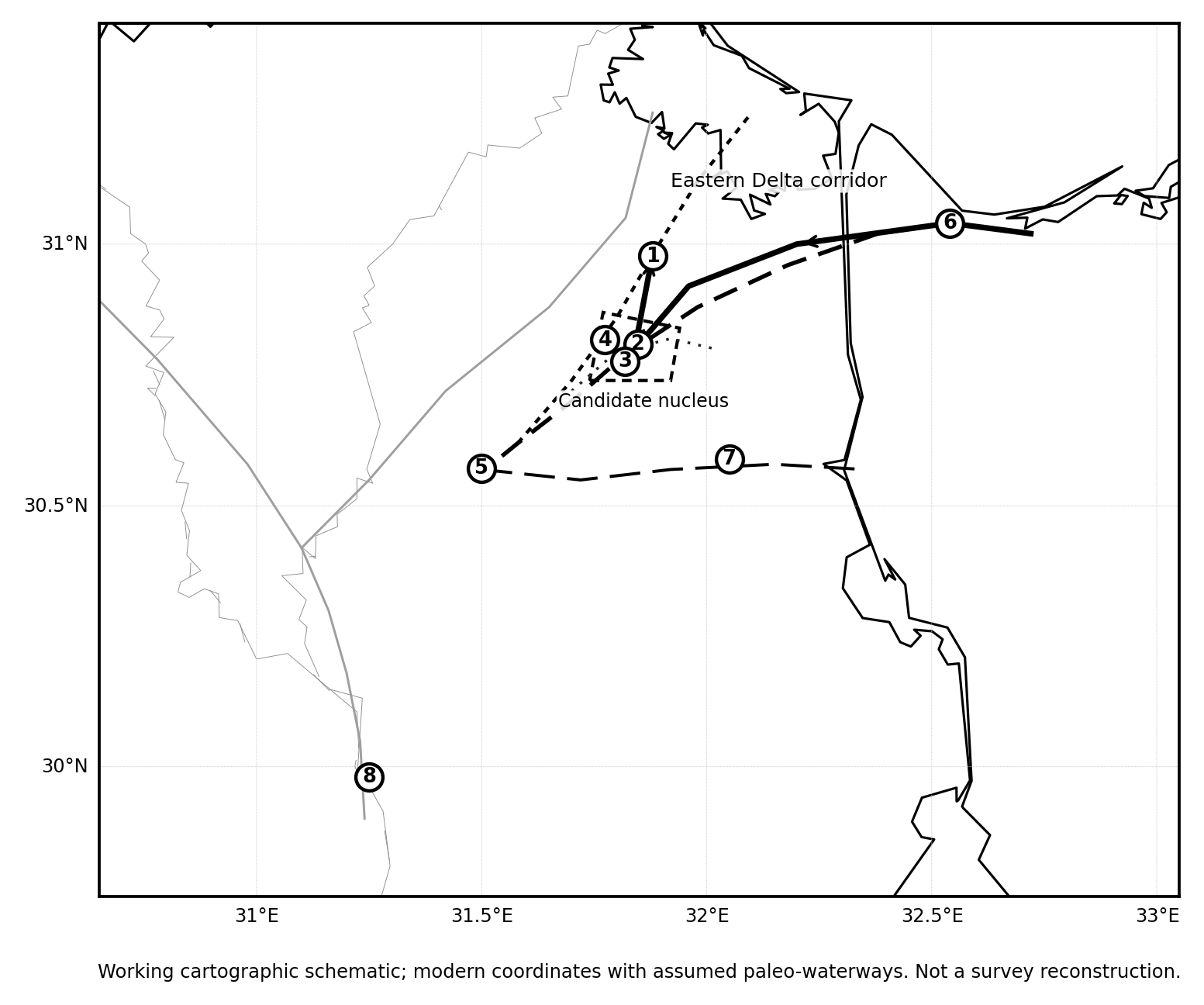
| Numbered place key 1 Tanis / Zoan / San el-Hagar 2 Qantir / Pi-Ramesses 3 Tell el-Dab‘a / Avaris 4 Ezbet Helmi / Area H 5 Bubastis / Tell Basta 6 Pelusium / Tell el-Farama 7 Wadi Tumilat / Goshen corridor 8 Memphis / Cairo region |
Line key and caution Solid black: proposed working route / “way to Zoan” Long dashed: assumed Pelusiac paleochannel Short dashed: assumed Tanitic / Zoan corridor Dash-dot: side branch / anabranching water Thin gray: modern/general Nile courses Dashed polygon: Avaris–Pi-Ramesses candidate nucleus This figure is a working schematic, not a survey reconstruction. |
The register shows why the thesis has become serious. The evidence clusters in four layers: botanical, hydraulic, architectural, and inscriptional. It does not yet yield identification. It yields a disciplined artifact-field.
The strongest responsible formulation is therefore this: the Avaris–Pi-Ramesses–Tanis corridor has produced an enclosed royal garden at Avaris, a cultic-water precinct around Seth/Baal and the harbor, a monumental canal-lake-palace complex at Pi-Ramesses, and a displaced sacred archive at Tanis/Zoan. If Moffatt’s Zoan-reading is granted, this corridor remains the strongest known material analogue for the phrase.
19. The Evidence Ladder
Not all evidence stands at the same height. The work must rank its own materials before its critics do so for it.
Rung I: Directly excavated features
The strongest ground-level evidence is Avaris: tree-pit garden, enclosure wall, water-supply system, harbor basin, and materially located cultic precinct. These features prove a royal garden-world. They do not prove that Genesis 13 names that world.
Rung II: Text-attested features with plausible material correlates
The second rung contains the gardens of Apophis, the Second Kamose Stela, harbor-memory, the Seth/Baal tradition, and the 400 Year Stela. Here text and soil begin to answer each other. Avaris is remembered as royal abundance and cultic ancestry. Yet the memory remains Egyptian and Hyksos/Ramesside; it must not be forced into Israelite identity.
Rung III: Reconstructed urban features based on survey
The third rung belongs chiefly to Pi-Ramesses: central island, canal, internal lake, massive temple, palace core, stables, harbors, and roads. This is the strongest structural analogue. It makes “park-city” intelligible as a composed sacred-watered geography, but it remains later and monumental. Its value is as heir and expansion, not as direct proof of Genesis 13.
Rung IV: Transferred and displaced artifacts
The fourth rung is Tanis/Zoan. Moved stones, obelisks, stelae, blocks, and temple materials show that Tanis materially inherited Pi-Ramesses. Tanis is therefore not necessarily the original park; it is the archive in which the older sacred-watered geography survived in displaced form.
Rung V: Theological-literary interpretation
The fifth rung returns to Scripture. Moffatt’s “the Eternal’s own park,” Hebrew gan, the field of Zoan, and Lot’s moral error give the artifacts interpretive significance. This rung is luminous, but dangerous. Theological coherence is not archaeological proof. The phrase remains a question before it becomes an answer.
The hierarchy can be stated severely:
Avaris gives the spade its strongest evidence. Pi-Ramesses gives the map its strongest structure. Tanis gives the thesis its strongest name. Genesis gives the search its governing question.
20. From Analogue to Near-Identification
A responsible analogue is not a failure. It is the place where serious scholarship begins to breathe.
The present thesis has reached disciplined maturity: the Eternal’s own park has not been found, but the Avaris–Pi-Ramesses–Tanis corridor has become the strongest responsible path from phrase to place. To move from powerful convergence toward near-identification, several forms of evidence would be required.
First, the textual basis for Zoan must be strengthened. Moffatt’s reading must be examined through versional history: Syriac, Greek, Latin, Samaritan, Targumic, medieval Hebrew witnesses, and the mechanics by which Zoar and Zoan may have been confused, corrected, or harmonized. Fruitfulness is not textual priority.
Second, the geography of the field of Zoan must be disciplined. The work must determine whether that field plausibly included Tanis alone, the marsh-pasture plain toward Pelusium, the Pi-Ramesses zone, or a broader royal-sacred Delta system. A field is not an excuse for vagueness.
Third, the hydrology must be reconstructed. Genesis 13 begins with a well-watered basin; therefore the Egyptian analogue must be mapped as branch, canal, basin, lake, marsh, garden, harbor, and route. Water alone proves nothing. Water joined to enclosure, cultivation, and divine-royal precinct becomes relevant.
Fourth, the garden-cult link at Avaris must be clarified. A tree-pit garden becomes more important if it can be shown to stand in functional relation to palace, water-supply, harbor, and Seth/Baal precinct. Evidence of procession, ritual deposits, or ceremonial use would strengthen the claim considerably.
Fifth, Pi-Ramesses must be plotted as a coherent sacred-watered composition, not as a list of impressive features. Island, canal, lake, palace, temple, harbor, stables, roads, and divine quarters must be shown in relation.
Sixth, the transmission chain to Tanis must be cataloged feature by feature. Which stones moved? From which precincts? Were they merely reused, or consciously re-enthroned as sacred memory?
Seventh, a direct ancient phrase would be decisive: an inscription, text, or tradition joining Zoan or its field with a divine garden, sacred grove, royal enclosure, or possessed park. Such evidence has not yet been produced.
The thesis must also survive rival explanations. Moffatt’s Zoan may be a secondary geographical correction. “The Eternal’s own park” may refer simply to Eden, with Egypt as a separate comparison. The Avaris–Pi-Ramesses evidence may be magnificent but unrelated. These alternatives must not be feared. A thesis that cannot endure rival explanations is not scholarship; it is desire.
Near-identification would require convergence across text, lexicon, geography, hydrology, artifact, and literary theology. Only then could one responsibly say that the Avaris–Pi-Ramesses–Tanis corridor is not merely an analogue, but the most plausible remembered geography behind Moffatt’s phrase.
21. Final Rule of the Search
The work ends not with possession, but with vocation.
The Eternal’s own park has not been found. Yet the road has become real enough to follow: text, field, water, garden, palace, harbor, temple, stela, city, stones, and Scripture. That is no small thing.
The final rule is therefore the first rule restored:
We do not need to exaggerate evidence to glorify God. We glorify Him by telling the truth.
If this path is fruitful, let it open. If flawed, let it be corrected. If premature, let it be restrained. If appointed for edification, let it be made clear.
Wonder opens the road. Evidence marks the path. Wisdom decides the pace.
Appendix A
Research Program and Field Questions
The research program proceeds in five stages: locate Zoan; reconstruct the way; recover the waters; distinguish city from precinct; and ask whether the Eternal’s own park is merely comparative poetry or the last visible edge of remembered sacred geography.
The evidence classes are textual, toponymic, hydrological, cultic, and covenantal-literary. Textual evidence includes Moffatt, the conventional Zoar reading, the Syriac Zoan witness, and internal biblical references to Zoan. Toponymic evidence includes Zoan, Tanis, Djanet, and San el-Hagar. Hydrological evidence includes Nile branches, paleochannels, lagoons, canals, marshes, sacred lakes, and the relation between water and settlement. Cultic evidence includes temples, sacred lakes, precinct walls, processional spaces, enclosures, and traces of earlier sanctity beneath later construction. Covenantal-literary evidence includes Genesis’s own use of geography – Eden, eastward movement, Egypt, Sodom, Mamre, Moriah, Bethel, Sinai – as more than setting. In Genesis, places do not merely contain events. They interpret them.
The field questions remain severe enough to discipline the imagination:
When Moffatt reads Zoan, what textual or philological judgment lies behind that departure from the common Zoar?
Was Zoan ever used broadly enough to include a surrounding field, district, or approach, rather than only the urban center?
What did the land of Egypt on the way to Zoan denote in geographical imagination: a route from Canaan into Egypt, a route inside Egypt toward Tanis, or a Delta district known by approach?
Where were the ancient watercourses near Tanis during the relevant historical horizons?
Did sacred precincts near Tanis cluster around water, grove, enclosure, temple, or processional approach?
Could a later temple landscape preserve the memory of an earlier sacred geography, even if not under the same theological name?
Does Genesis 13 compare the Jordan basin to Eden, to Egypt, or to a more specific Egyptian sacred district whose identity has been flattened by later translators?
The program must avoid two opposite errors. The first is timidity: to see Moffatt’s Zoan, notice the strangeness, and retreat immediately into the safe majority reading as though safety were identical with truth. The second is intoxication: to find Tanis, find a sacred lake, find a vanished branch, and immediately declare the Eternal’s park discovered. Both errors are unworthy. The proper posture is disciplined astonishment.
Not: we have found it. Rather: we now know where to begin looking.
Figure 1 provides a non-stylized schematic of the proposed corridor. It should be treated as a working visual aid, not as a survey-grade reconstruction.
Appendix B. Bibliographic Orientation and Source Markers
James Moffatt, The Old Testament: A New Translation, especially Genesis 2-3 and Genesis 13:10; Moffatt’s preface on fresh translation, modern research, and the rendering of the divine name as “the Eternal.”
Cambridge Bible note on Genesis 13:10, noting the Syriac Peshitta/Peshitto reading Zoan and its connection with the fertile district of Tanis in the eastern Nile Delta.
BibleHub interlinear and commentary resources for Genesis 13:10; Psalm 78:12 and 78:43; Numbers 13:22; Isaiah 19:11; Isaiah 30:4; and lexical materials for Hebrew gan.
Britannica entries on Tanis/Zoan and Per Ramessu/Pi-Ramesses, including Tanis as biblical Zoan and the royal-sacred significance of the northeastern Delta.
École Pratique des Hautes Études / French Mission for the Excavations of Tanis, especially material on Tanis, the Tanitic branch, lagoons, canals, and paleo-environmental context.
Oxford Artefacts of Excavation: Tanis / San el-Hagar, including Amun temple enclosure, sacred lake, Khons-Neferhotep temple, and Mut precinct.
Reuters report on the discovery of a pharaonic-era sacred lake in the temple of Mut at ancient Tanis.
Austrian Archaeological Institute / Austrian Academy of Sciences materials on Avaris / Tell el-Dabʿa, Hyksos Avaris, and the southern part of Pi-Ramesses.
Manfred Bietak and related excavation summaries on Avaris, the palace garden, tree-pits, enclosure walls, water-supply systems, harbor, and the gardens of Apophis in relation to the Second Kamose Stela.
Studies by Steven Snape and others on the Pelusiac branch, Pi-Ramesses, Qantir, Avaris, geziras, harbors, temples, and the transfer of Ramesside monuments to Tanis.
Bible Odyssey, Hoffmeier/Rendsburg, and related discussions on Goshen, Wadi Tumilat/Tjeku, Succoth, Pithom, Pi-Ramesses, Avaris, and eastern Delta geography.
Resources on ancient Egyptian gardens, temple gardens, sacred groves, enclosure walls, ponds, canals, and Egyptian sacred landscape grammar, including Cambridge, Liverpool Museums, and comparative materials from Bubastis.
Lexical resources including Brown-Driver-Briggs, Blue Letter Bible, and NET notes for gan and pardes, to distinguish Edenic enclosure-garden from later Persian-derived royal parkland terminology.